More than just a tour company, it’s memories of a lifetime that can’t be experienced anyway other than in person. Gil Serique and his team went above and beyond anything I could have imagined in my life.
The back story:
I found Gil quite by accident, and I’m lucky that I did. I’d been riding my motorcycle around the world and it was suggested to me that if I make it to the Amazon in Brazil I try to spend a night camping at Gils place. I arrived after a three day boat trip with my motorbike from Manaus to Santarem, and then road into Alter Do Chao where Gil is located. I don’t think I’d slept for the three days on the boat and Gil had messaged to say he wouldn’t be home, but to make myself at home at his place. I awoke later in a hammock on his patio to a fan blowing across me that someone had put to cool me down. Awaking to a welcome fan would set the tone for an entire month of ongoing hospitality.
While riding my motorbike on the crazy amazon roads near Gils I had broke my rear shock. Gil and his team jumped in to help me with the Portuguese language, organizing parts and getting them shipped to his house. During my month waiting for parts I was part of three of Gil Seriques Amazon tours. Wow, I could not have been more blessed. I got to be part of two historical tours into the Tapajos rainforest forest where Gil’s family once lived. The tour is about 5-hours long and focuses heavily on the history of the area and Brazil’s significance during the rubber boom, and where it is headed now with the Soya bean boom.
The Tapajos rainforest tour included:
• King Vulture sightings
• Roasting nuts in the rainforest & season local fruit sampling
• Visual demonstration of how a swarm of ants are used as mosquito repellant
• A tour to a GIANT Kapok tree
• A brisk rainforest hike
• Rubber tree extraction demonstration
• View of the barren remains of where Gils family used to live in the rainforest
• Snacks and drinks at Gils property in Alter DO Chao afterwards
• 45-minute bus ride each to the rainforest and back on “Amazon Roads”
• A full English explanation of the history of the area
• A drive through Bellatara for a brief explanation of its history along with Henry Ford and the rubber boom
The Tapajos rainforest tour is excellent for anyone with a keen interest in the history of the Amazon rainforest, the rubber boom and knowing the relationship the Gils family had with rubber boom.
The Floodplains river explorer tour
• Picked up at the docks in Santarem
• 5-hour boat tour on a two-story boat that could hold 5-50ppl
• Pink and grey dolphin watching
• Hoatzin spotting
• Three-toed sloth spotting
• An amazing ride down the river on fun and spacious boats
• An interactive explanation of the area and it’s history, flora, and fauna
• Snacks and drinks on the boat. Including sample some of the local fish
For me this tour focused heavily on wildlife spotting, which Gil and his team have an amazing eye for. I personally enjoy wildlife more than history, but here you get a bit of both. The animals are wild but on this day we were blessed with pink & grey dolphins, parrots, turtles, hoatzins, sloths and more. To see pink dolphins in the wild is an experience I will never forget.
Gil Serique, his partner Loic, cousin Celso, friend Pierre, and everyone else who looked after me for my month in Alter Do Chao and during the tours went unimaginably out of their way to make me feel like family and right at home. The hospitality was 5-stars just like the tours, and with glowing reviews from people like Alan Dean Foster, the author of Star Wars, Star Trek and Alien. You are sure to be in professional hands.
The day I left I cried as I drove away, and for a grown man who stumbled upon Gil completely by mistake, you could only be so lucky to spend the day on one of his tours…
The amazon rainforest is like nowhere else on earth, and Gil Serique is like no other character on earth either.
KixMarshall.com
Showing posts with label cruiseship. Show all posts
Showing posts with label cruiseship. Show all posts
Tuesday, 5 February 2019


Friday, 16 November 2012


Monday, 2 January 2012
Pacific Princess Part I (January 2nd 2012
  |
| Pink dolphin |
 |
| She is so nice |
 |
| Gil Serique lecturing for his mates |


 |
| snack time |
 |
| Grey dolphins |

 |
| spotting sloths |

 |
| Three-toed sloth |
Saturday, 30 July 2011
The cruise ship industry in my country
Jul 25, 2011
After growing 20 percent annually over the past ten years and reaching a level of 800,000 tourists annually, the pace of cruise expansion in Brazil is expected to encounter a sharp slowdown in the 2011-2012 season.
Ricardo Amaral, Royal Caribbean CEO in Brazil and head of the Association of Maritime Cruises Ricardo Amaral, Royal Caribbean CEO in Brazil and head of the Association of Maritime Cruises
The estimated expansion in the supply of beds is only 1.6%. The main reason is the infrastructure deficiencies of Brazilian ports, which have no more room for receiving large vessels. Given this scenario, it will mark the first time a cruise season will have fewer vessels than the last: 17 instead of 20.
Brazilian industry executives say that the trend, if port infrastructure remains unchanged, is for the industry to rearrange its size, because it may have grown far more than ports capacity.
“The sector's growth will slow down. There is insufficient investment in ports. The system is at the limit” says the president of the Association of Maritime Cruises (Abremar), Ricardo Amaral, also Royal Caribbean CEO in Brazil.
However Brazil’s Ports Secretariat reported that it is well aware of maritime demand growth. “The Ports Secretariat (SEP) is building six terminals for the World Cup 2014 which demand an investment of 740 million Real (approx 460 million US dollars). All projects are going to be leased out in due time and they will all be finished by 2013”.
Italy’s MSC Cruises is planning a 34% drop in the number of beds this coming season as well as in overall sales, although the percentage was not released. Adrian Ursilli head of MSC marketing said the company will be operating one vessel less, a reduction of 70.000 beds this season which will be transferred to operations in the Arab Emirates.
“Last year we transported 300.000 South American tourists of which 250.000 Brazilian. This coming season the number will drop to 200.000”, estimated Ursilli. However he also pointed out that MSC, Abremar, Brazil Ministry of Tourism have been jointly working together with other government offices to find a solution to the port bottlenecks.
Royal Caribbean is also bringing a cruise vessel less this season to the South Atlantic. It will be operating with two vessels but estimates a growth of 30% in the number of tourists since it has extended the season 20 days, which means the number of calls will increase from 44 last season, to 51 in 2011/2012.
“With less supply, there’s an overall natural tendency for cruise trips prices to increase, even more if the bookings are made at last moment”, points out Amaral, head of Caribbean Brazil, “prices could go up as much as 20%”.
Amaral revealed that according to a recent survey from the Getulio Vargas Foundation (FGV) 70% of cruise passengers are what he described as “first time mariners”, meaning tourists that have been attracted by the so called thematic cruises.
This refers to cruises that present singers, television actors, football players and even different styles of music such as ‘heavy metal’ Amaral estimates that anywhere from 10% to 20% of cruises in a season are thematic. The total number of calls for the 2011/2012 season is estimated in 386.
The FGV survey also revealed that the 2010/11 season had an economic impact for the Brazilian tourist industry equivalent to 900 million US dollars, which includes expenditure by tourists, crew members and services to vessels.
More specifically on ports’ capacity, Santos which is the most commonly used by cruise vessels, can only receive one vessel at a time at the passengers’ terminal. However the Companhia Docas from the State of Sao Paulo reported that the expansion plan for the World Cup 2014 includes increasing docking capacity to six vessels. The budget earmarked for the works totals the equivalent of 200 million dollars.
Rio do Janeiro on the other hand can currently receive up to seven vessels simultaneously and it is planned to expand docking capacity by 73%, at a cost of another 200 million dollars approximately.
After growing 20 percent annually over the past ten years and reaching a level of 800,000 tourists annually, the pace of cruise expansion in Brazil is expected to encounter a sharp slowdown in the 2011-2012 season.
Ricardo Amaral, Royal Caribbean CEO in Brazil and head of the Association of Maritime Cruises Ricardo Amaral, Royal Caribbean CEO in Brazil and head of the Association of Maritime Cruises
The estimated expansion in the supply of beds is only 1.6%. The main reason is the infrastructure deficiencies of Brazilian ports, which have no more room for receiving large vessels. Given this scenario, it will mark the first time a cruise season will have fewer vessels than the last: 17 instead of 20.
Brazilian industry executives say that the trend, if port infrastructure remains unchanged, is for the industry to rearrange its size, because it may have grown far more than ports capacity.
“The sector's growth will slow down. There is insufficient investment in ports. The system is at the limit” says the president of the Association of Maritime Cruises (Abremar), Ricardo Amaral, also Royal Caribbean CEO in Brazil.
However Brazil’s Ports Secretariat reported that it is well aware of maritime demand growth. “The Ports Secretariat (SEP) is building six terminals for the World Cup 2014 which demand an investment of 740 million Real (approx 460 million US dollars). All projects are going to be leased out in due time and they will all be finished by 2013”.
Italy’s MSC Cruises is planning a 34% drop in the number of beds this coming season as well as in overall sales, although the percentage was not released. Adrian Ursilli head of MSC marketing said the company will be operating one vessel less, a reduction of 70.000 beds this season which will be transferred to operations in the Arab Emirates.
“Last year we transported 300.000 South American tourists of which 250.000 Brazilian. This coming season the number will drop to 200.000”, estimated Ursilli. However he also pointed out that MSC, Abremar, Brazil Ministry of Tourism have been jointly working together with other government offices to find a solution to the port bottlenecks.
Royal Caribbean is also bringing a cruise vessel less this season to the South Atlantic. It will be operating with two vessels but estimates a growth of 30% in the number of tourists since it has extended the season 20 days, which means the number of calls will increase from 44 last season, to 51 in 2011/2012.
“With less supply, there’s an overall natural tendency for cruise trips prices to increase, even more if the bookings are made at last moment”, points out Amaral, head of Caribbean Brazil, “prices could go up as much as 20%”.
Amaral revealed that according to a recent survey from the Getulio Vargas Foundation (FGV) 70% of cruise passengers are what he described as “first time mariners”, meaning tourists that have been attracted by the so called thematic cruises.
This refers to cruises that present singers, television actors, football players and even different styles of music such as ‘heavy metal’ Amaral estimates that anywhere from 10% to 20% of cruises in a season are thematic. The total number of calls for the 2011/2012 season is estimated in 386.
The FGV survey also revealed that the 2010/11 season had an economic impact for the Brazilian tourist industry equivalent to 900 million US dollars, which includes expenditure by tourists, crew members and services to vessels.
More specifically on ports’ capacity, Santos which is the most commonly used by cruise vessels, can only receive one vessel at a time at the passengers’ terminal. However the Companhia Docas from the State of Sao Paulo reported that the expansion plan for the World Cup 2014 includes increasing docking capacity to six vessels. The budget earmarked for the works totals the equivalent of 200 million dollars.
Rio do Janeiro on the other hand can currently receive up to seven vessels simultaneously and it is planned to expand docking capacity by 73%, at a cost of another 200 million dollars approximately.
Source: caribbeannewsdigital.com
Sunday, 8 May 2011

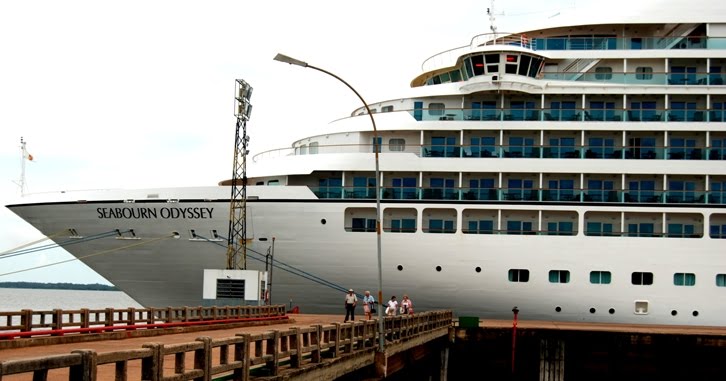


Special Cruiseship Tour (Part I)
 Black collared hawk is often seen    The Meeting of the waters  |
| Time for reading a bit and rest or birdwatching |
 |
| No time to sit and eat though, only fresh fruit, nuts and tid bits are served |
 |
| Nice, safe and clean boats |
 |
| We use our own guide books |


Join us and maximize your brief staying in the Amazon. Our tour focus on wildlife observation and History, and groups are limited to 10 people.
We would like to say a big thank you for 2 of the most wonderful days we have ever spent ashore from a cruise ship. We lovedddddd! every minute of it. You were so knowledgeable, entertaining and funny and we are still smiling today. A few photos you may like to see are attached. People on the ship have asked how we managed to be so few on our boat and they were so many - you remember we passed 2 or 3 Seabourn tourists boats. We have told so many people on board about our super guide and the days you planned for us.
We have already looked on Amazon to buy the books you were involved with and hopefully these will arrive in England when we arrive home.
Thank you again - we just loveddddd it.
Kind regards
 |
| Sloths observation are guaranteed and many birds too |
 |
| Close-up and personal experiences |
 |
| Exploration and adventure |
 |
| Santarem as the birds see it |

 |
| Trophy photographs even with snapshot cameras |

Subscribe to:
Posts (Atom)